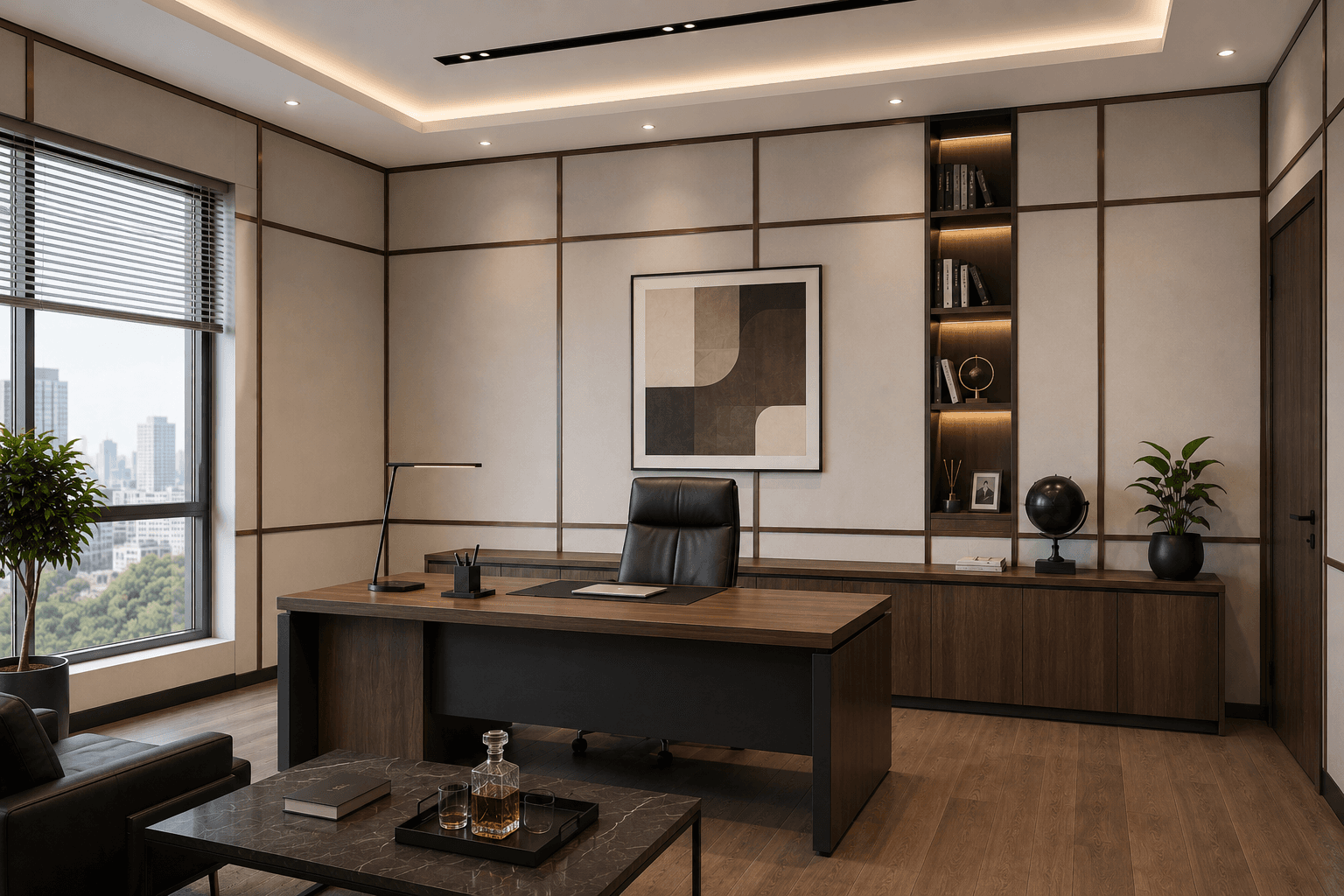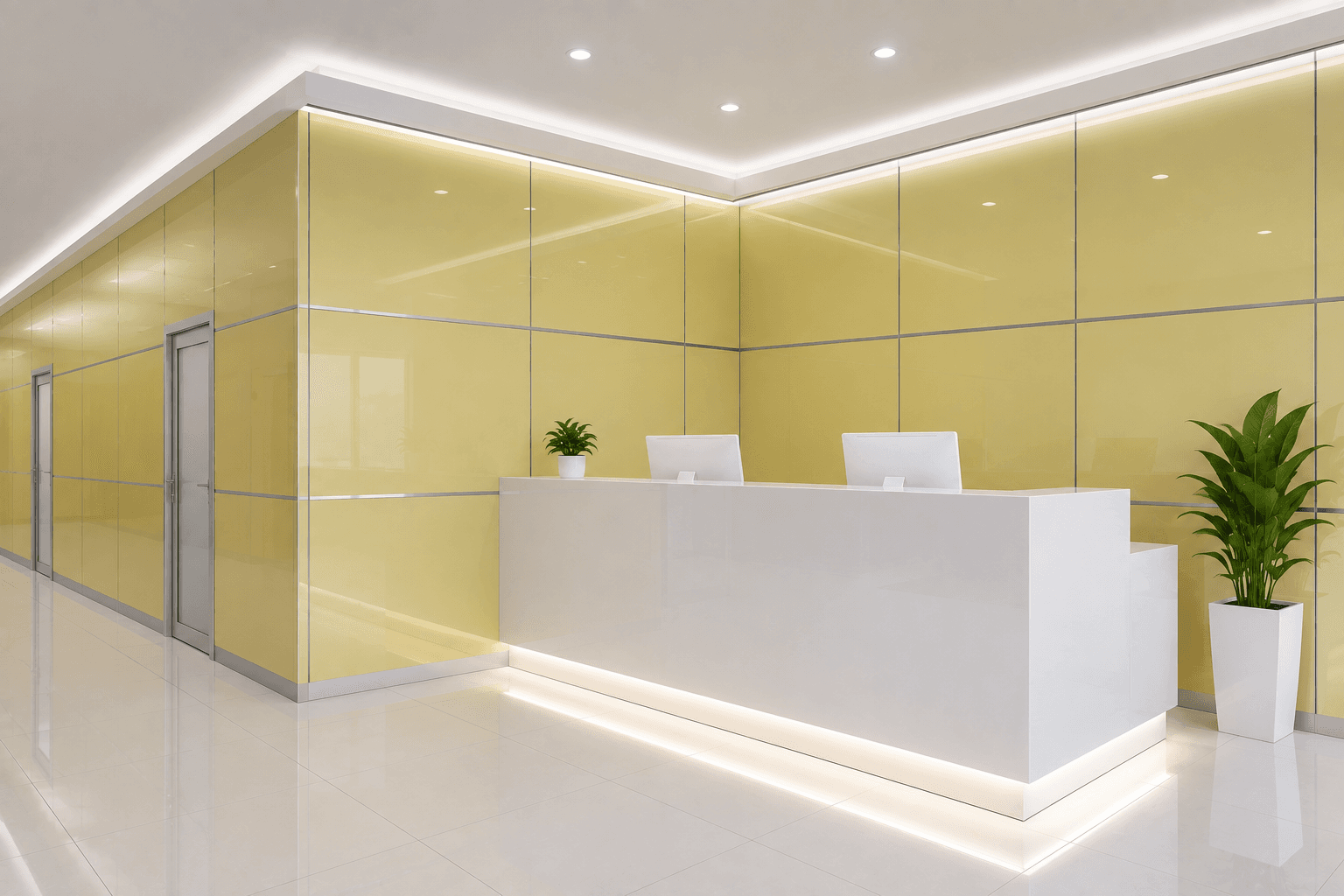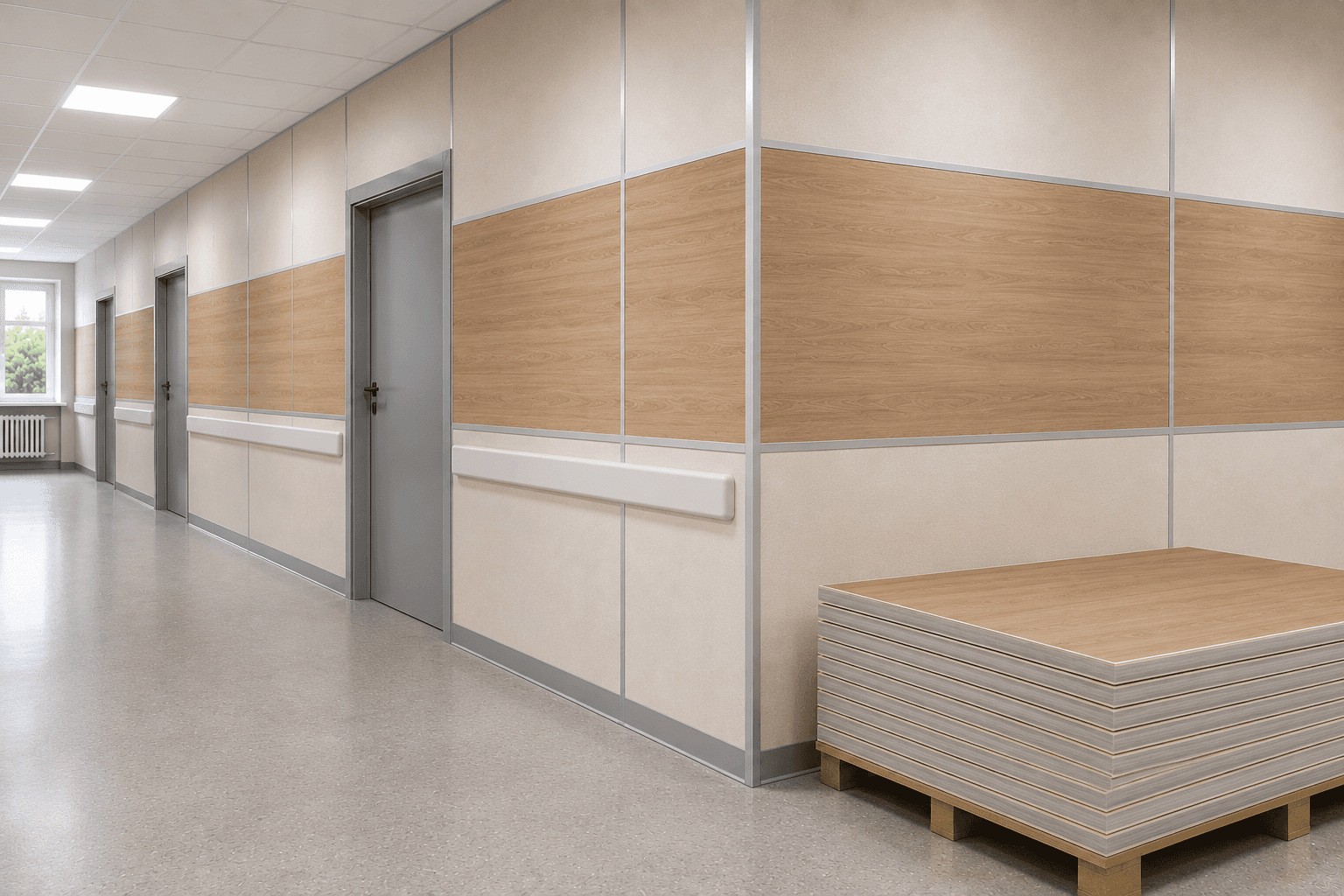
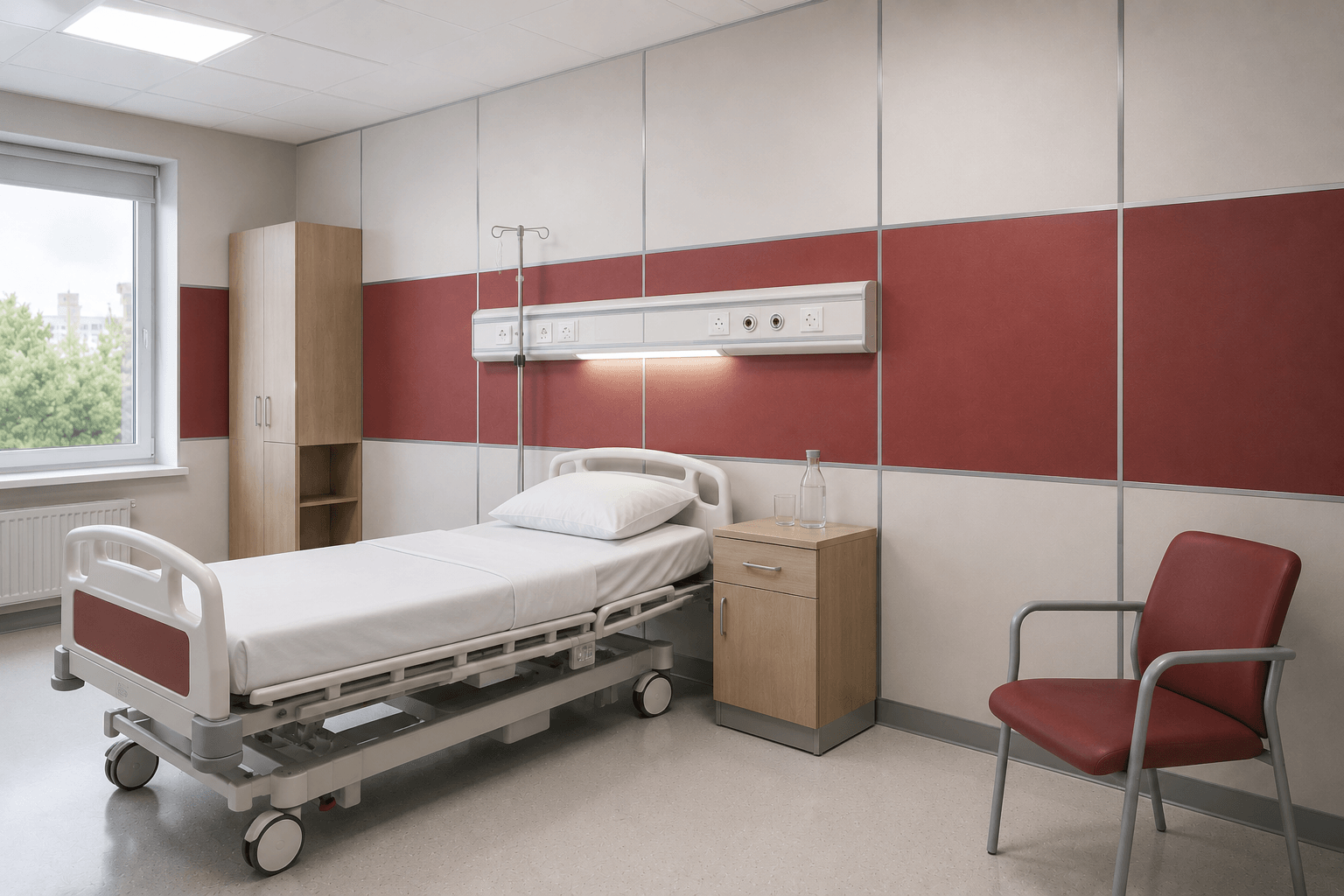
Wall panels in medical institutions in 2027: the main trends in hospital decoration
Trends in 2027 in the decoration of hospitals and medical facilities: hygienic wall panels, acoustics, fire safety, impact resistance, sealed joints, and quick repairs without long downtime.
In 2027, wall decoration in hospitals, clinics, diagnostic centers, and other medical facilities is increasingly perceived as an ordinary decorative material.
A wall in a medical facility must simultaneously be part of the interior, withstand intensive use, be easy to clean, meet the requirements of a specific room, and allow for quick repairs.
That is why system wall panels are becoming one of the notable trends in modern medical construction.
It is not just an alternative to painting, tiling or traditional plastering. The panel system allows you to organize the entire finishing process differently - from installation to maintenance and local repairs.
This direction is especially relevant for Ukraine. The current DBN V.2.2-10:2022 "Healthcare institutions. Basic provisions" contains separate requirements for decoration, hygiene, acoustics, clean rooms and operational characteristics of materials. In particular, for premises in the care and treatment area, decoration materials must have provisions for use in healthcare institutions in the manufacturer's instructions and meet sanitary and anti-epidemic requirements.
Trend #1. The panel becomes part of the system, not a separate material
A few years ago, wall panels were often chosen based on the following principles: color, texture, price, and appearance.
This is not enough for a modern medical facility.
In 2027, the finishing system is of increasing importance.
The panel should work together with:
mounting subsystem;
decorative profiles;
sealing joints;
door and corner assemblies;
engineering communications;
access areas for maintenance;
cleaning and disinfection requirements.
Global publications on the design of medical facilities also focus on a systemic approach: not only the characteristics of the panel itself are important, but also the joints, communication penetrations, adjacency to the floor, door frames, and other elements.
This is of fundamental importance for the hospital.
After all, it is the joints and complex nodes that often become places where dirt accumulates and create additional difficulties during cleaning.
Trend #2. Hygiene becomes one of the main selection criteria
A medical interior should not only be beautiful.
It needs to be cleaned regularly.
Therefore, in 2027, the importance of surfaces that can be effectively cleaned and maintained according to the protocols of a specific healthcare facility is increasing.
This especially applies to:
operating rooms;
procedural;
dressings;
chambers;
corridors;
reception departments;
laboratories;
diagnostic rooms;
waiting areas.
The current DBN for healthcare facilities separately establishes requirements for room decoration materials, and for rooms that must meet a certain cleanliness class, walls must meet the requirements for clean room surfaces according to DSTU ISO 14644-1.
Therefore, the future of medical finishing is in surfaces whose characteristics can be clearly defined and documented.
Trend #3. Tight and well-thought-out joints
In medical facilities, it is not enough to simply install large panels.
Equally important is how they connect to each other .
The fewer complex and hard-to-reach areas, the easier it is to maintain the premises in proper condition.
Therefore, modern finishing systems are moving in the direction of:
minimizing open joints;
controlled geometry of joints;
sealing where provided for by design;
corner protection;
thoughtful connections;
node cleaning capabilities.
For GYPSUN®, this is especially relevant because of its own system of decorative profiles.
Omega profile, Pi profile, T profile, L profile and F profile allow you to form controlled panel connection nodes and corner solutions.
At the same time, a decorative profile may not just be a technical element.
It becomes part of the architecture of the wall.
Trend #4. Acoustics becomes part of medical design
A hospital is one of the most challenging environments in terms of noise.
Patients, staff, trolleys, medical equipment, doors, ventilation, alarm systems and other sources create a constant acoustic background.
Ukrainian DBN V.2.2-10:2022 directly provides for measures to protect medical institutions from external and internal sources of acoustic energy. The sufficiency of such measures must be confirmed by appropriate calculations.
This means that acoustics are no longer just a matter of comfort.
She becomes part of the project.
Modern medical interiors can use:
sound-absorbing wall panels;
acoustic ceilings;
special partitions;
soundproofing structures;
combined solutions.
It is important not to confuse sound absorption with sound insulation .
The first reduces sound reflections inside the room.
The second limits the transmission of sound through the structure.
In a good medical project, these tasks can be solved simultaneously.
International recommendations for the acoustic design of medical buildings also consider acoustics as a comprehensive system - from room acoustics to noise control of engineering equipment and sound insulation of structures.
Trend #5. Walls must withstand real use
In a hospital, walls are in constant contact with people and equipment.
Medical carts.
Beds.
Wheelchairs.
Mobile diagnostic equipment.
Cleaning.
Personnel relocation.
Therefore, the decorative surface must take into account mechanical loads.
This is especially important for:
corridors;
reception departments;
operational blocks;
chambers;
rehabilitation centers;
diagnostic departments.
The current DBN separately states that facing materials for walls and doors in psychiatric wards must be impact-resistant and meet the safety parameters specified by the medical task.
So, in 2027, the decorative panel in a hospital is increasingly seen as an operational structure , rather than simply a finishing coating.
Trend #6. Renovation without long-term closure of the medical department
This is one of the most practical trends.
The hospital cannot operate like a regular construction site.
Closing a facility for several months for renovation often means losing some of the facility's functionality.
Therefore, rapid installation systems are becoming increasingly relevant.
Panel finishing allows you to reduce the number of traditional wet processes:
plasters;
puttying;
multilayer painting;
prolonged drying.
This is especially important during the reconstruction of an already operating hospital.
Repairs can be organized in stages.
For example:
today - part of the corridor;
tomorrow - a separate office;
after that, there is a waiting area.
This approach allows for better process control and reduced downtime.
Trend #7. Panels are used for quick access to engineering systems
A modern hospital is a complex engineering system.
Behind the walls can pass:
electrical cables;
low-current systems;
pipelines;
ventilation communications;
medical gases;
communication systems;
other engineering networks.
Therefore, the wall should not only be beautiful.
It must take into account the possibility of maintenance.
This is where panel systems can have an advantage over monolithic finishes.
With proper design, access to the necessary areas can be provided without large-scale destruction of the entire wall.
This reduces maintenance time and makes future repairs easier.
Trend #8. The “hospital” interior is disappearing
Another notable trend is the change in the visual perception of medical institutions.
A hospital no longer has to necessarily look like a hospital.
White color, cold lighting and monotonous walls are gradually giving way to more calm and thoughtful interiors.
Modern medical design uses:
natural shades;
wood textures;
soft colors;
accent walls;
clear navigation;
different lighting scenarios;
materials with a tactilely pleasant and calm appearance.
At the same time, decorativeness should not contradict hygienic and operational requirements.
That is why modern manufacturers of surface materials for healthcare facilities pay attention to design, durability, cleaning and infection control at the same time. Market reviews of medical building materials also show a growing interest in decorative wall panels, acoustic systems and durable surfaces for healthcare projects.
Trend #9. Fire performance remains a basic requirement
Design cannot replace safety.
For medical facilities, the issue of fire safety is of particular importance due to the large number of people, patients with limited mobility, the complex structure of the building, and the large number of engineering systems.
Therefore, when choosing wall panels, it is necessary to evaluate not only the decorative coating.
Important:
panel base;
fire reaction class;
system design;
installation method;
joints;
materials used;
compliance with project requirements.
For a specific object, the characteristics must be confirmed by relevant technical documentation and documents of conformity.
Trend #10. Finishes are designed with future renovations in mind
In 2027, a good medical interior is not one that looks beautiful immediately after opening.
This is an interior that remains functional after several years.
Medical facilities are constantly changing.
New equipment appears.
The office is being moved.
The functional purpose is changing.
New communications are needed.
Part of the cladding needs to be replaced.
Therefore, a modular approach becomes increasingly logical.
The panel system allows you to consider the wall as a structure that can be maintained, changed, and partially repaired.
This is especially important for large hospitals, where the renovation of one corridor or department should not automatically turn into a large-scale reconstruction of the entire floor.
GYPSUN® and a new approach to walls in healthcare facilities
For GYPSUN®, this trend means a transition from the simple concept of a “decorative panel” to a system wall solution for public and medical facilities .
The panel must be considered together with the profiles, joints, installation, operation and requirements of the specific room.
For medical facilities, the following are especially important:
hygiene;
possibility of regular cleaning;
durability;
mechanical resistance;
fire safety;
acoustic comfort;
installation speed;
possibility of local repair;
access to utilities;
documented characteristics.
It is the complex of these factors that will determine the quality of the medical interior in 2027.
Why traditional repair is gradually giving way to system panels
Classic wall decoration often creates a long chain of work.
Surface preparation.
Plaster.
Puttying.
Priming.
Dyeing.
Drying out.
Repainting after a few years.
In a medical facility, each such stage means additional time, dust, organizational difficulties, and potential limitations on the operation of the facility.
The panel system changes the logic.
Instead of constant surface repair, a structure is used that can be designed with future operation in mind.
That is why quick repairs without long downtime become one of the most practical arguments in favor of modern wall panels.
What will medical interiors look like in 2027?
It is impossible to predict the future of design with certainty.
But several trends are already visible.
Medical facilities are becoming more humane by design.
At the same time, more technical requirements are being placed on surfaces.
Hygiene combined with design.
Acoustics - with comfort.
Fire safety — with architecture.
Modularity — with the speed of repair.
And the wall panel ceases to be just a decorative surface.
It becomes part of an engineered medical interior system .
This is precisely one of the main trends of 2027: hospital walls should not just look good - they should be adapted to the real life of a medical institution.
For GYPSUN®, this means creating solutions in which the decorative panel, profile system and installation technology work together.
GYPSUN® — wall systems for modern medical and public spaces.