Perforated Soundproofing Panels: How Acoustic Wall Panels Work and Where to Use Them
Perforated soundproofing panels help reduce echo, boominess, and sound reflection in a room. Learn how acoustic panels work, how sound absorption differs from sound insulation, and where perforated panels are best used.
Noise in a room isn't always caused by thin walls or inadequate soundproofing. Often, the problem lies elsewhere: hard surfaces reflect sound waves, causing a hum, echo, decreased speech intelligibility, and increased overall acoustic discomfort.
That is why perforated panels for noise insulation and sound absorption are used for offices, educational institutions, medical facilities, conference rooms, corridors and other public spaces.
But here it is important to understand the terms correctly.
A perforated panel is not a universal replacement for a full-fledged soundproofing structure. Its main purpose is to absorb some of the sound energy within the room and reduce the amount of reflected sound . This approach is precisely what is required by regulatory requirements for acoustics in public buildings.
Soundproofing or sound absorption – what’s the difference?
These concepts are often used as synonyms, although they describe different processes.
Soundproofing is needed to reduce the transmission of sound from one room to another. For example, when it's necessary to reduce noise penetration from a hallway to an office, from an adjacent room to a patient's room, or from a technical room to a work area.
Sound absorption works directly within the room. The acoustic structure absorbs some of the sound energy that would otherwise be reflected off walls, ceilings, and other hard surfaces.
DBN B.1.1-31:2013 explicitly requires the use of sound-absorbing cladding to reduce noise levels, reduce room noise, improve speech intelligibility, and create acoustic comfort. Multilayer systems with perforated cladding are also listed among the designs used.
Therefore, it is more correct to talk about perforated acoustic panels for sound absorption when it comes to improving the acoustics inside a room.
How do perforated acoustic panels work?
An ordinary smooth hard surface reflects a sound wave to a large extent.
Walls, ceilings, glass, metal, or other rigid materials can create multiple reflections. If there are many such surfaces, the room becomes resonant. A person hears not only the direct sound from the source but also its many reflections.
Perforation changes the behavior of the sound wave.
Perforations in the panel allow sound energy to pass to the sound-absorbing layer located behind the decorative surface. Depending on the system design, perforation, material thickness, air gap, and the characteristics of the sound-absorbing layer, the absorption efficiency of various frequencies varies.
Therefore, the mere presence of holes does not make the panel acoustic .
The whole structure is important.
That is why, when choosing perforated panels for soundproofing, you need to consider not only the appearance, but also:
type and size of perforation;
percentage of perforated area;
panel thickness;
back side design;
the presence of a sound-absorbing layer;
the size of the air gap;
installation method;
the frequency range in which absorption must be achieved;
total area of acoustic cladding.
Why is perforation important for acoustics?
The perforated surface works as part of the acoustic system.
The sound wave enters the openings and interacts with the structure located behind the panel. If the decorative surface is covered with appropriate sound-absorbing material and an air gap, some of the sound energy is not reflected back into the room.
As a result, it is possible to reduce:
boominess;
echo;
excessive reverberation;
reflection of speech;
acoustic discomfort;
overall level of reflected noise.
Moreover, effectiveness depends on the specific design. Regulatory documents also emphasize that the result is determined by the characteristics of the room, the area of the cladding, the location of the sound-absorbing structures, and their acoustic properties.
Perforated wall panels: where are they needed?
Acoustic wall cladding is especially important in areas where there are many people at the same time or where language intelligibility is important.
Offices
In open offices, noise is created by conversations, phone calls, equipment operation, and the constant movement of people.
If a room has many hard surfaces, sound is reflected multiple times. This makes it difficult to concentrate and communicate.
Perforated wall panels can be used as part of a comprehensive acoustic solution.
Schools and educational institutions
For classrooms, lecture halls and other learning environments, language intelligibility is important.
Students should be able to clearly hear the teacher, and the teacher should be able to clearly hear the students. Excessive echo impairs information comprehension even when the noise level doesn't seem critical.
Acoustic wall and ceiling lining helps control reflected sound and create a more comfortable environment.
Medical institutions
In hospitals, clinics and medical centers, acoustic comfort is of particular importance.
Noise is generated by staff activity, patient movement, doors, equipment, ventilation systems and other sources.
In corridors, hallways, waiting areas and other public spaces, acoustic panels can be part of a comprehensive noise reduction system.
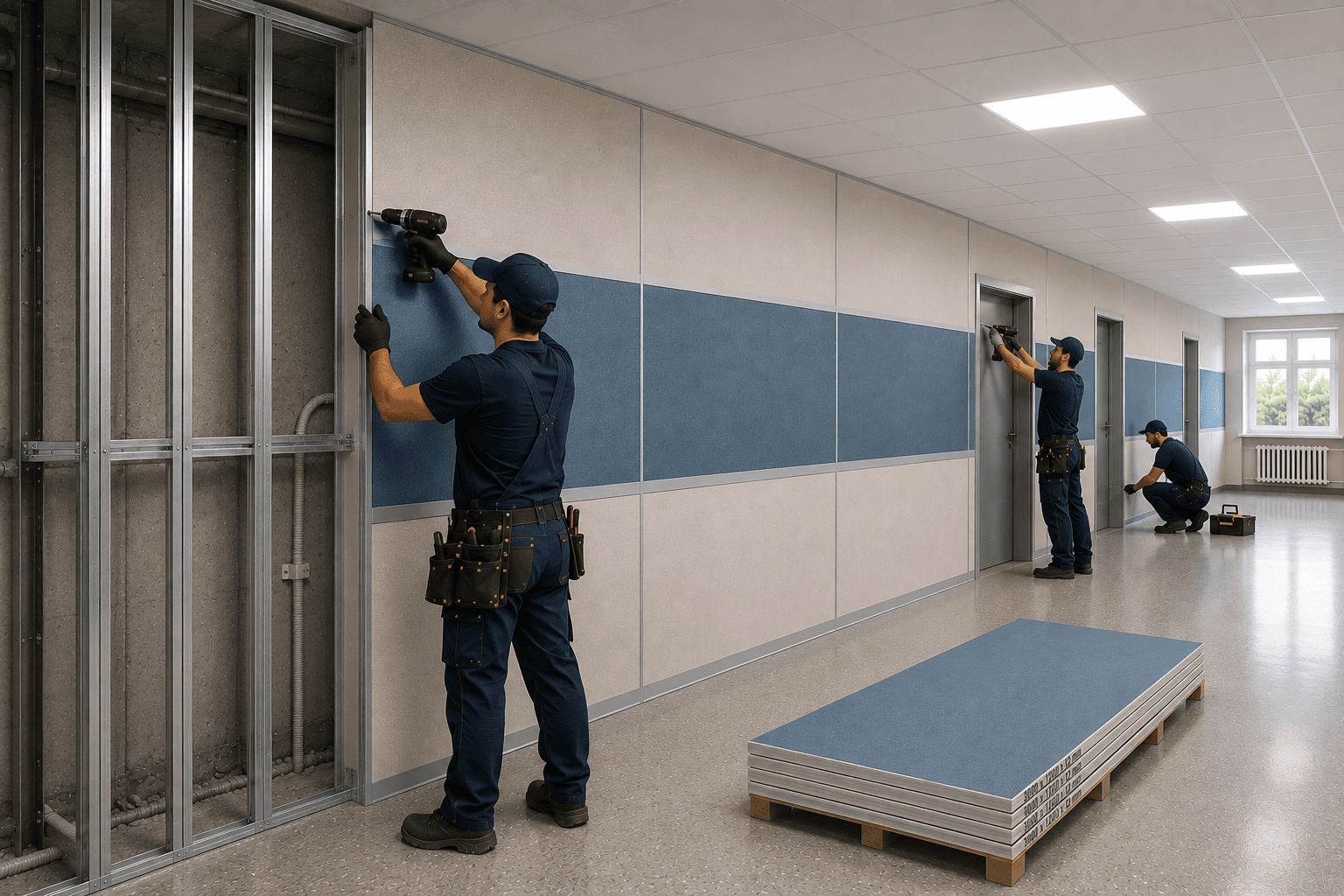
For such facilities, acoustic properties aren't the only important consideration. The surface must meet the specific requirements for durability, hygiene, cleanability, mechanical strength, and fire safety. These requirements for sound-absorbing structures are also stipulated by the State Building Code.
Conference halls and meeting rooms
Here, the main goal is often not absolute noise reduction, but rather improving speech intelligibility .
When sound reflects off walls and ceilings, voice clarity can become blurred. Perforated acoustic panels help reduce unwanted reflections.
Public spaces
Perforated panels can be used in:
halls;
receptions;
corridors;
waiting rooms;
administrative premises;
cultural and educational facilities;
rooms with a large number of people.
What determines the efficiency of perforated panels?
It is a mistake to judge an acoustic panel solely by its appearance.
Two panels with the same perforation may exhibit different acoustic characteristics.
The reason lies in the design of the system.
1. Perforation geometry
The diameter of the holes, their shape, pitch and total perforation area are important.
2. Sound-absorbing material
The perforated decorative surface often works together with the material behind it.
It is this combination that determines a significant part of the acoustic characteristics.
3. Air gap
The distance between the panel and the base also affects the performance of the acoustic structure.
Changing the air gap can change the frequency response of sound absorption.
4. Facing area
One small panel on the wall cannot give the same effect as a properly calculated acoustic paneling over a large area.
DBN notes that the required area of sound-absorbing cladding should be determined taking into account the acoustic characteristics of the room and the results of the corresponding calculation.
5. Location
Equally important is where exactly the panels are installed.
In certain rooms, it is advisable to treat the most acoustically active surfaces, such as large walls or areas that reflect direct sound.
Can perforated panels be called sound insulation?
In household searches, users often enter the query "perforated panels for noise insulation" .
For SEO purposes, this query should definitely be used.
But the technically correct term depends on the task.
If it is necessary to reduce the transmission of sound through a wall, a soundproofing structure is needed.
If you need to reduce sound reflection inside a room, you need sound absorption .
In practice, these solutions can work together.
For example, a partition can be constructed with enhanced sound insulation, and its surface can be additionally lined with perforated acoustic panels. The first solution limits sound transmission through the structure, while the second controls sound reflection within the room.
It is the integrated approach that allows us to obtain a predictable acoustic result.
Perforated panels and interior design
An acoustic solution does not necessarily have to look like technical equipment.
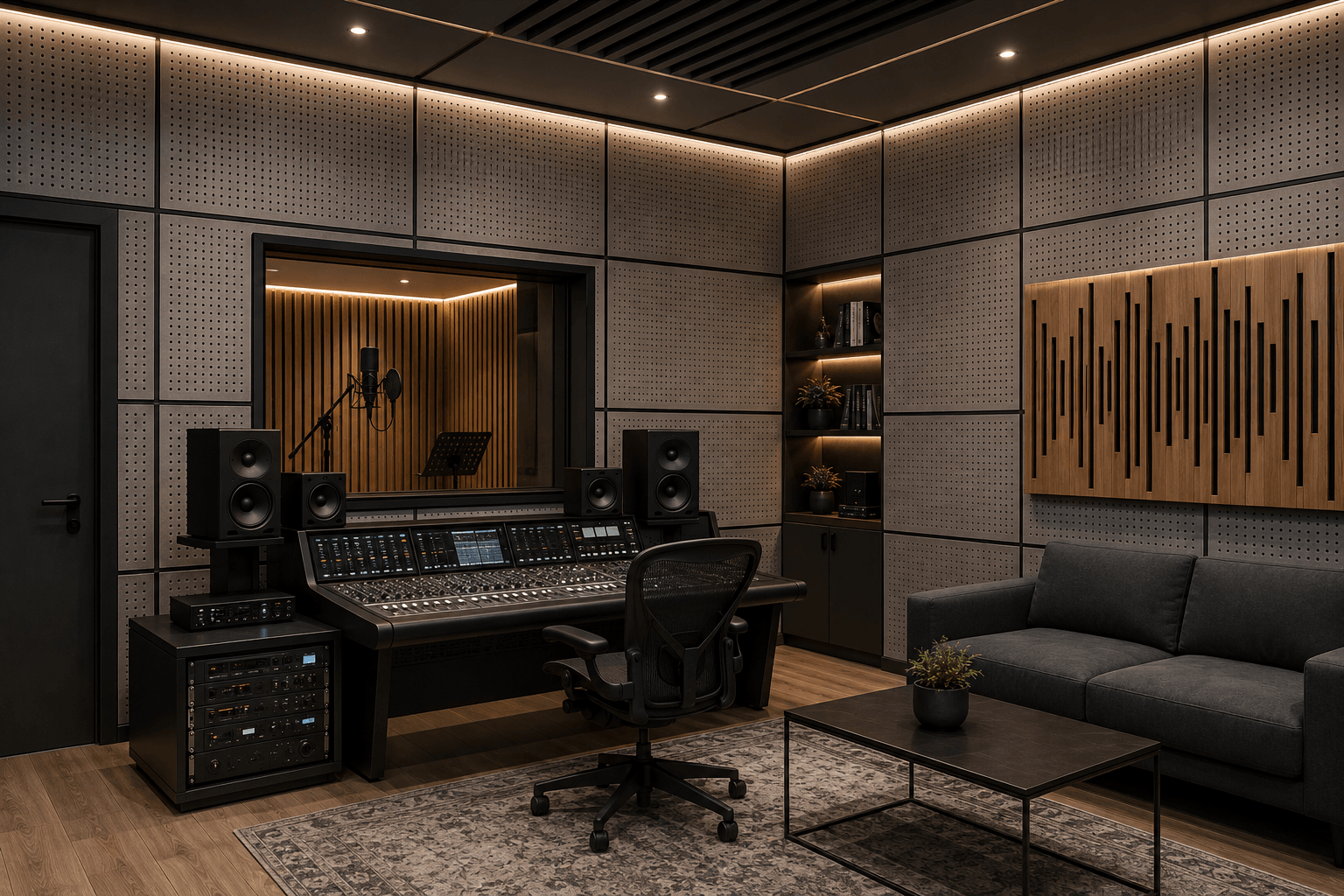
Modern perforated panels can be part of architectural design.
The perforation shape, pitch, placement, and surface color allow for a variety of visual solutions. The panels can be used on individual accent walls or to form a larger cladding area.
This is especially important for public buildings.
The material must simultaneously perform a practical function and fit into the architecture of the room.
This is why acoustic panels are now considered not only as a means of combating noise, but also as an element of interior decoration.
Are perforated panels suitable for medical and public facilities?
Yes, but the choice of a specific design must take into account the operating conditions.
For medical institutions, schools, administrative buildings and other public facilities, it is important to evaluate more than one indicator.
It is necessary to take into account:
fire characteristics;
strength;
durability;
possibility of purification;
surface durability;
hygiene requirements;
acoustic characteristics;
installation features;
compatibility with engineering equipment systems.
DBN B.1.1-31:2013 specifically notes that sound-absorbing structures must comply with sanitary, hygienic, fire safety and general construction requirements.
Therefore, for a public or medical facility, you should not select an acoustic panel based solely on a catalogue or photograph.
How to choose the right perforated panels for soundproofing?
You need to start not with choosing a design, but with defining the acoustic problem.
First you need to understand:
What exactly needs to be reduced?
Noise from equipment?
Month?
Thickness?
Speech intelligibility?
Transmitting sound between rooms?
Next, the characteristics of the room are determined:
square;
height;
volume;
wall materials;
ceiling type;
number of hard surfaces;
noise sources;
purpose of the premises;
the required level of acoustic comfort.
After this, you can determine the type of sound-absorbing structure, its area and installation location.
This approach is consistent with the regulatory logic of noise protection design. The State Building Regulations (DBN) stipulate the determination of the required sound absorption capacity, the number of sound-absorbing structures, and their effective placement, taking into account the room's geometry and noise sources.
GYPSUN® perforated panels as part of an acoustic system
For GYPSUN®, perforated panels can be considered as a separate direction of acoustic wall cladding.
Their advantage is the ability to combine the functionality of a wall panel, decorative design, and acoustic performance in a single solution.
In this case, acoustic efficiency should be determined not only by the type of panel, but also by the entire installation system.
The following become especially important:
perforation type;
panel design;
sound-absorbing layer;
mounting subsystem;
air gap;
cladding area;
panel layout diagram
For large public buildings, this allows acoustic cladding to be designed not as a random decorative element, but as part of the overall finishing system of the space.
Perforated panels are more than just holes in the wall.
Quality acoustics begins with a proper understanding of the physics of sound.
Perforation alone does not guarantee sound insulation. Effectiveness depends on a properly selected design, in which the panel, perforation, sound-absorbing material, air gap, and installation system work together.
Therefore, when choosing perforated panels for sound insulation, you should look not only at the design and price per square meter.
It is necessary to understand what acoustic problem the system solves.
If you need to reduce the transmission of noise between rooms, you need soundproofing.
If the main problem is echo, boominess and multiple sound reflections, sound absorption is needed.
And in many modern facilities, both solutions are needed simultaneously.
This is why acoustic wall cladding with perforated panels is becoming an important part of the design of offices, medical facilities, schools, public buildings, and other spaces where acoustic comfort directly impacts the quality of people's stay.
GYPSUN® – system solutions for modern wall finishing.