Construction worker shortage: how to reduce labor costs with panel technology
When there are not enough builders, the problem is not only in salaries. All repairs become more expensive. The GYPSUN™ panel frame system allows you to reduce the number of operations, labor intensity and dependence on a large number of specialists.
The shortage of construction workers has become part of the renovation economy
A few years ago, when planning a renovation, the main issue was the price of materials.
Today this is no longer enough.
You need to find people who can do the work. And not just find a few employees, but form a team, provide it with work, and control deadlines and quality.
And here a problem arises.
Traditional finishing often consists of a large number of sequential operations. Each of them requires its own skills. Plastering. Puttying. Sanding. Priming. Painting.
The more operations, the more people.
The more people, the more difficult it is to organize work.
And if there are not enough qualified specialists on the market, the cost of their labor naturally increases.
Therefore, today the question "how to save on construction workers?" is gradually changing to another:
"How to design a repair so that it requires fewer labor operations?"
This is where the conversation about panel systems begins.
You need to save money not on people, but on unnecessary work.
This is a fundamental point.
Reducing your budget shouldn't mean paying your employees less or looking for the cheapest crew.
This approach often ends in rework.
Savings arise differently.
If ten operations are required to obtain a finished wall, and the technology allows you to do five, then it is not only time that is saved.
The number of working hours is decreasing.
The number of specialists involved is decreasing.
Control becomes easier.
The construction cycle is shortened.
And this is real savings.
Traditional repairs require a whole sequence of work
Let's imagine a simple wall decoration.
First, the surface needs to be prepared.
Then align.
After that, apply plaster.
Wait for it to dry.
Carry out puttying.
Wait again.
Polish.
Prime.
Paint.
And if the surface is not smooth enough, some of the work will have to be repeated.
At every stage, there is a human factor.
One craftsman did it well. Another did it worse. One did it in a day. Another needed two.
In a large facility, such a difference quickly turns into weeks.
Panel mounting changes the very logic of work
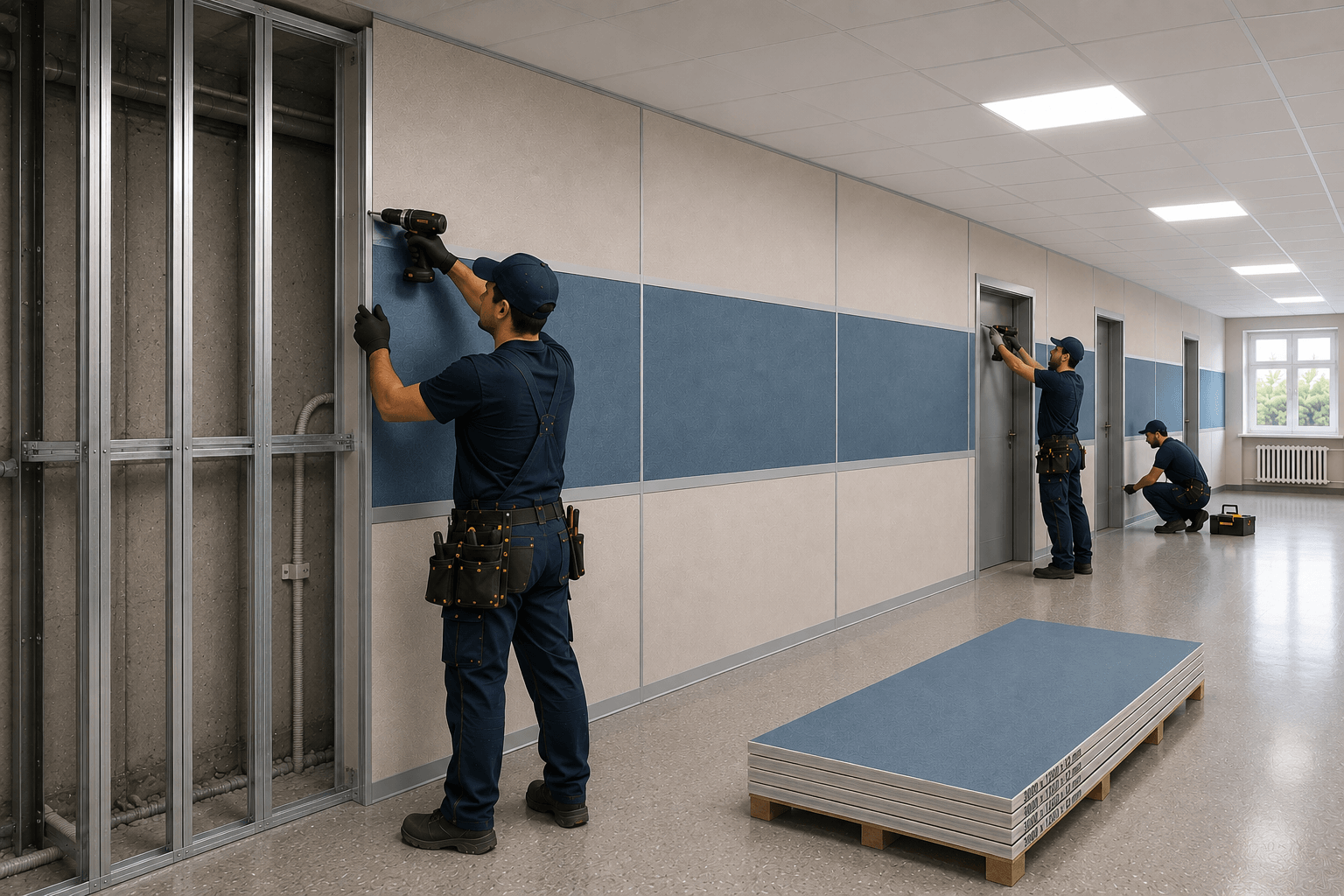
The GYPSUN™ frame system is built on a different principle.
First, the mounting base is formed.
Then panels are installed on it.
Connections are made through a profile system.
Mounting elements are closed with decorative profiles.
The surface immediately takes on a finished look.
There is no need to transfer all the stages of classic decoration to the object.
This is important not only because of speed.
The fewer technological operations, the fewer working hours are required to obtain the finished result.
One installer does not replace the entire crew. But the system allows you to reduce its workload.
It is important not to exaggerate here.
Panels don't mean that professional builders are no longer needed.
High-quality installation always requires a responsible attitude, accuracy, and adherence to technology.
But there is a big difference between the two situations.
In the first case, the worker spends a significant portion of his time preparing the material and correcting the surface.
In the second, it works with ready-made system elements.
This is a fundamentally different level of complexity.
The shortage of specialists is especially noticeable at large facilities.
On a small repair, the difference may be imperceptible.
But imagine a school, hospital, or administrative building with thousands of square meters of walls.
This is no longer about a few days.
Even a small saving of time per square meter, multiplied by a large area, gives a significant result.
That is why for budget construction it is important to calculate the labor intensity of a square meter , and not just its material cost.
What does laboriousness mean in practice?
This is the amount of working time required to complete a certain amount of work.
And here panel systems have a clear advantage.
Instead of a large number of disparate processes, the installer works with a ready-made system.
Panel.
Frame.
Profile.
Fastening.
Joint.
Decorative closure.
The more logically the system is built, the less time is spent on unforeseen operations.
The GYPSUN™ profile system works as part of the technology
That is why you should not consider the panel separately from the profile.
GYPSUN™ develops panel and profile systems as interconnected elements .
The omega profile joins the panels on a flat plane.
The U-profile covers the visible screw caps and forms a neat connection line.
The T-cap covers the mounting area of the omega profile and creates a continuous joint line.
The L-profile is used for internal corners.
F-profile - for external.
An aluminum skirting board completes the system in the floor area.
All this allows the installer to work not with a set of random parts, but with a well-thought-out system.
Fewer specialists — simpler facility organization
A large brigade is not only a payroll fund.
This is also an organization.
It is necessary to coordinate the work of various specialists.
We need to provide them with materials.
It is necessary to control the sequence of operations.
It is necessary to ensure that one team does not wait for the other to complete their work.
Every such delay costs money.
Frame installation makes the process more compact.
No need to constantly switch between dozens of types of work.
Fewer employees means less dependence on the labor market
This is another important advantage.
If the technology requires ten specialists and only six are available on the market, the construction schedule begins to collapse.
You can wait.
You can overpay.
You can hire less experienced workers.
Or you can change the technology itself.
That is why the shortage of construction workers is forcing the market to look for solutions not only in the field of hiring.
Automate production.
Optimize logistics.
Simplify installation.
Reduce the number of operations.
Panel systems are part of this process.
Installation speed becomes an economic category
Quick installation is often perceived as just convenience.
Actually, it's money.
Fewer working days.
Less labor costs.
Less construction equipment rental.
Less costs for organizing the site.
Less time until the premises are put into operation.
That is why when comparing technologies, you need to look not only at the price of the material.
Wet-free repair reduces the number of operations
Another factor is the rejection of a large number of wet processes.
Plastering and painting work takes time.
The material needs to dry.
The premises must meet certain conditions.
The next stage cannot always be started immediately.
Panel installation using frame technology largely transfers the work to the level of drywall installation.
This reduces technological pauses.
And a technological pause is also time that someone pays for.
Dust-free – less work after work
There is another simple thing.
The construction site needs to be cleaned.
Sanding walls creates dust.
Dismantling creates waste.
Wet processes leave behind material waste.
Each such process requires additional work.
Panel mounting allows to significantly reduce the number of dusty processes.
This is especially important in existing buildings.
This issue is particularly acute for schools and hospitals.
In a typical new construction project, you can close the premises for several months.
But renovating an existing hospital or school has a different logic.
The building must continue to operate.
Therefore, technologies are needed that allow:
work in stages;
minimize dust;
shorten deadlines;
quickly return the premises to operation;
not to employ an excessive number of employees.
It is in such conditions that labor savings become particularly noticeable.
Qualification still matters
There is a dangerous extreme.
After seeing the simple installation, you can decide that any person with a tool is enough to do the job.
This is wrong.
The simplicity of the technology does not mean the absence of requirements.
It is necessary to correctly execute the frame.
You need to maintain geometry.
You need to set up the profiles correctly.
It is necessary to adhere to the fastening technology.
But the difference is different.
A qualified installer spends their time on installation, not on fixing complicated wall preparation.
Saving on builders should not mean saving on quality
This is probably the most important rule.
You can't just reduce the number of people and expect the same result.
It is necessary to reduce the required number of labor operations .
This is what makes the technology effective.
If the system allows you to achieve the same result faster, with fewer operations and without unnecessary steps, this is a technological saving.
Simply replacing a professional craftsman with a casual worker is already a risk.
The shortage of people is changing construction itself
The construction market is gradually moving towards systems that require less manual labor.
This is logical.
If previously the problem was solved by increasing the number of employees, today they are increasingly trying to change the process itself.
The factory produces a finished element.
It is installed at the facility.
Instead of dozens of small operations, there are a few clear ones.
This is the industrial approach to repair.
The panel system as an answer to the labor shortage
GYPSUN™ develops exactly this principle.
The panel is manufactured in advance.
The profile system is developed for specific installation tasks.
Decorative elements allow you to complete joints and fastenings.
Installation takes place without the need to repeat the entire cycle of classic decoration on the site.
Therefore, part of the work is transferred from the construction site to production .
And this is one of the most important changes.
The process can be controlled at the factory.
Installation remains on site.
What does the customer get?
Not just a faster installation.
He gets a different cost structure.
Fewer work operations.
Less dependence on the number of available specialists.
Fewer technological pauses.
Less dust.
Fewer wet processes.
Faster completion of individual zones.
And the ability to plan repairs more accurately.
The price of an employee is not only the salary
This is important to consider when drawing up an estimate.
The cost of labor actually includes:
salary;
taxes and organizational costs;
downtime;
accommodation and logistics if employees are recruited from another region;
tool;
CONTROL;
processing;
project manager time.
Therefore, reducing labor intensity can have a greater effect than it seems at the first stage of calculation.
The winner is not the one who finds the cheapest builder
This is no longer a question of dumping.
If a qualified specialist is expensive, you need to use his time rationally.
There is no point in paying a professional for work that could be done with technology itself.
He needs to do what really requires his qualifications.
This is how the modern approach to construction optimization works.
Conclusion
The shortage of construction professionals is not a temporary inconvenience that can be solved only by raising salaries.
It changes the economics of repair.
When there are not enough people, technologies that allow you to perform the same amount of work with less effort become important.
GYPSUN™ frame panel systems make it possible to reduce the number of finishing operations, switch to dry installation, perform work faster, and use qualified workers more effectively.
Here, savings do not arise from reducing demands on people.
It arises due to the reduction of unnecessary work .
And this is a fundamental difference.
Because the future of budget construction is not about finding more builders.
And it's about allowing fewer people to do more work in the same amount of time — without losing quality and while respecting technology .