
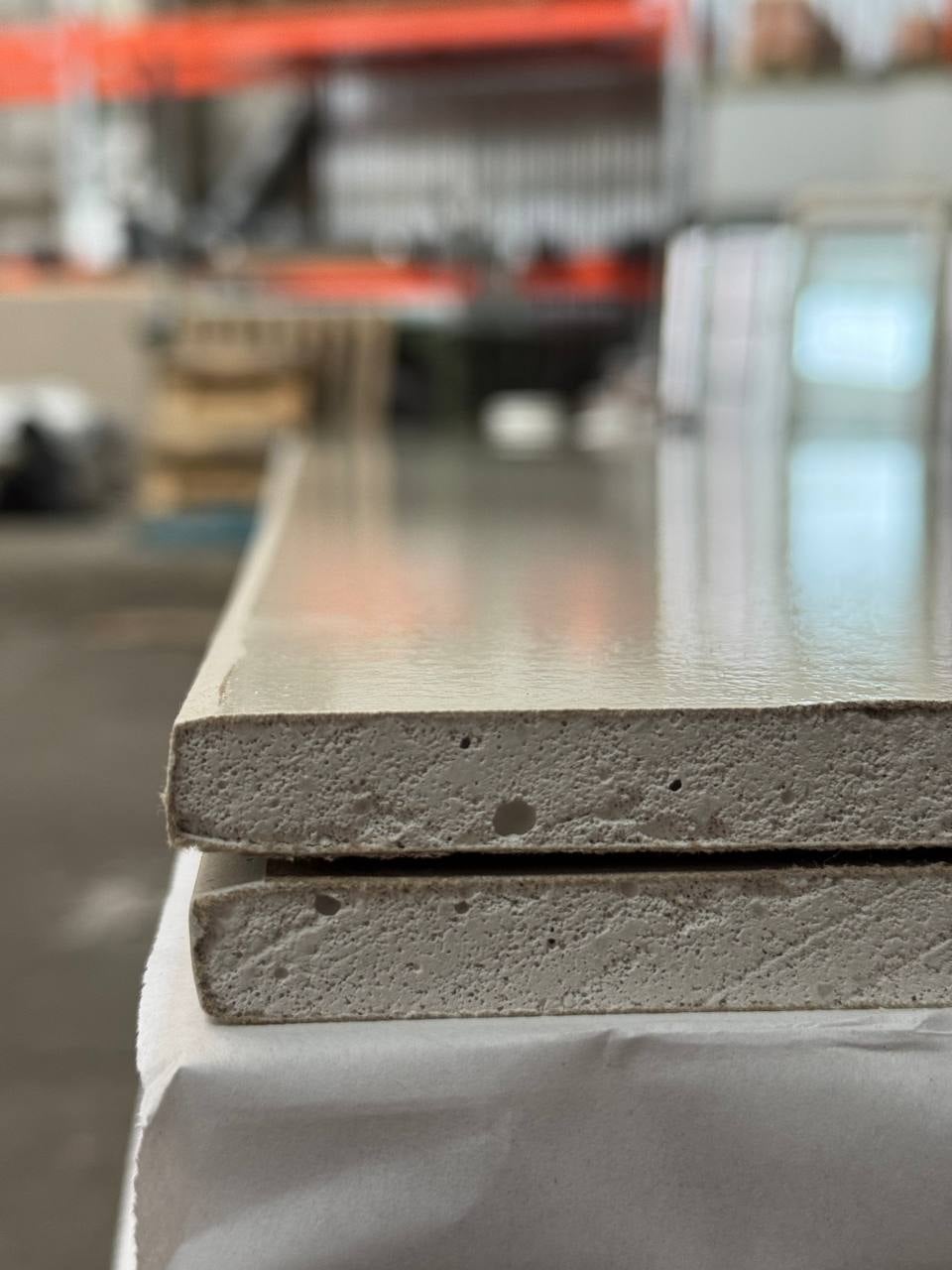
Cutting GKL for Lamination — It's Not Modernisation, It's System Destruction
Cutting factory-format GKL for a 'straight edge' for lamination is a technological error that leads to layer separation, loss of stable geometry, and installation problems. We explain why the 1200 mm standard is critical for system construction.
In the production of decorative panels, there is often a temptation to 'adapt' gypsum plasterboard for decorative lamination by cutting the edge to obtain a supposedly cleaner straight edge. In practice, this is not an improvement — it is interference with the engineering logic of the material.
Gypsum plasterboard is a multi-layered system. Its strength, geometry, and stability are built into the manufacturing process. Any deviation from the factory format is a risk to the entire structure.
1. Layer Separation — An Inevitable Consequence
GKL consists of a gypsum core and a paper envelope. The paper itself provides:
reinforcement of the board;
surface stability;
adhesion in mounting systems;
resistance to mechanical loads.
Cutting the edge for a 'straight line' violates the factory structure of the edge. In the cut zone:
the gypsum core is exposed;
adhesion is reduced;
risk of paper separation appears;
during lamination, the adhesive works on an unstable base.
The result is delamination. The film or decorative layer begins to work independently from the base. In the long term, this leads to blistering, layer separation, and loss of operational properties.
The system, which should be monolithic, becomes a compromised construction.
2. Violation of Sheet Geometry
The standard width of gypsum plasterboard is 1200 mm. This is not a random number. It is:
calculated for the pitch of a metal frame;
a modular installation system;
joint optimisation;
predictable design.
When a sheet is cut, its actual dimensions change. Even minor deviations create:
accumulation of error over the area;
joint misalignment;
problems with profile attachment;
need for on-site fitting.
On large projects, this becomes a chaos in wall geometry. Installers are forced to compensate for errors, increasing work time and risk of mistakes.
Construction is a system of modules. When a module is violated, the entire logic of the frame is destroyed.
3. Violation of the Frame Grid
Frame systems are designed for a standard width of 1200 mm. This allows:
maintaining the profile pitch;
ensuring uniform load distribution;
guaranteeing structure stability.
When a non-standard format is used, there is a need to:
change the profile pitch;
add extra elements;
compensate for deviations;
adapt drawings on site.
This is no longer a factory system — this is manual fitting. And fitting in series construction always means loss of quality control.
4. Lamination Does Not Fix Geometric Error
Some manufacturers believe that a decorative layer 'masks' problems in the base. But this is flawed logic.
Lamination:
does not restore edge structure;
does not compensate for loss of reinforcement;
does not return the standard size;
does not make the base stronger.
On the contrary — the film adds additional load to an unstable edge. If the base is weakened, the decorative layer only highlights the defect during operation.
5. Industrial Error versus Factory Standard
A factory GKL sheet with a straight edge at 1200 mm is the result of a technological cycle:
geometry control;
standardised width;
stable joints;
predictable installation.
Any 'alternative' sizes are already fitting, not a standard. On large projects, fitting means:
material waste;
increased installation time;
complexity of quality control;
risks during inspection.
On public and commercial buildings, this is unacceptable.
6. The Economics of Error
At first glance, cutting may look like a way to 'improve' the product. But in fact, it creates:
additional manufacturing operations;
risk of defects;
increased installation costs;
reduced system lifespan;
potential complaints.
Material that loses factory geometry is no longer a system solution. It is a local attempt at adaptation without engineering justification.
Conclusion
Cutting the base of gypsum plasterboard to get a straight edge for lamination is a technological error that:
provokes layer separation;
disrupts sheet structure;
destroys factory geometry;
creates problems with frame installation;
violates the 1200 mm standard.
Construction works on modularity and precision. A standard is not a limitation, but a quality guarantee. A 1200 mm sheet with a factory straight edge is a system solution. Everything else is fitting that increases risks.
Today's market requires stable, non-combustible, and geometrically controlled materials. Deviation from the standard is not innovation. It is a return to manual chaos in series construction.


