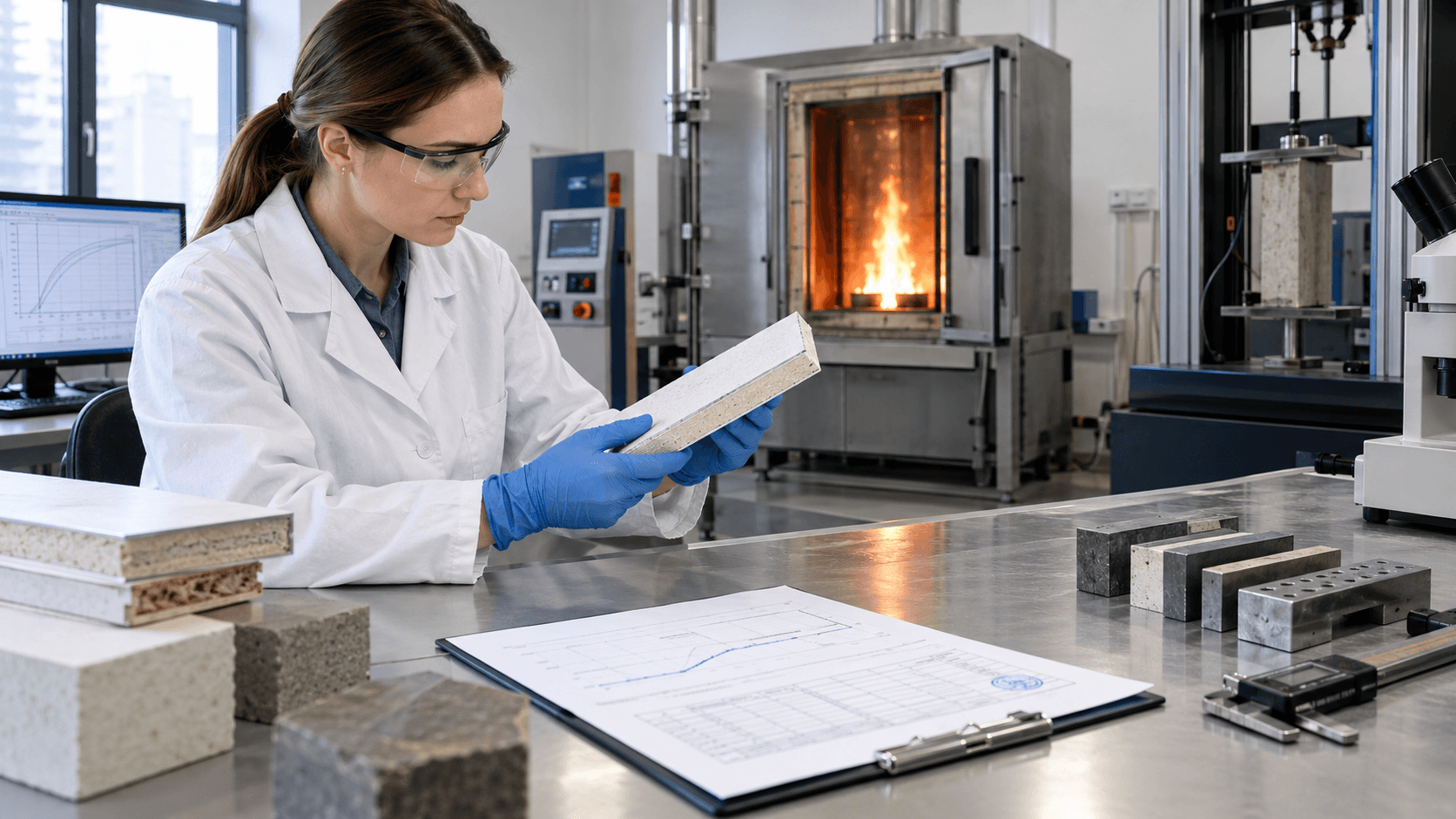

Not all panels are the same. Why genuine engineering solutions cannot be copied
Behind the superficial similarity of modern wall panels can lie entirely different engineering solutions. In this article, we explain why the professional market increasingly chooses not just a material, but a manufacturer capable of guaranteeing quality, manufacturing efficiency and responsibility for every completed project.
Not all panels are the same
The construction market has a remarkable property. It never remains empty. As soon as a new technology appears that changes our understanding of modern finishing, dozens of similar solutions emerge almost immediately. First they replicate the form. Then the colours. Later they begin to copy textures, technical descriptions, photographs of completed interiors. After a while, to an outside observer, it might seem that all materials have become identical, and the choice comes down to nothing more than a figure in the commercial proposal.
It is precisely at this moment that the greatest illusion of modern construction is born.
Architecture has never evaluated materials based solely on what the human eye sees. A building does not read marketing brochures. It does not know brand names and pays no attention to beautiful presentations. Its daily language is load-bearing, temperature fluctuations, moisture, mechanical impact, thousands of touches and years of continuous operation.
This is why two panels that appear almost identical in a photograph can tell completely different stories just a few years later.
One will remain as flat, precise and neat as the day it was installed. The other will begin to reveal weak points in the structure. And the problem almost never remains limited to the decorative surface.
The real difference is always hidden much deeper.
It is not born in the showroom.
Not in the catalogue.
And not even at the moment of sale.
Its beginning is in the design office, where engineers spend hours debating over drawings. In production workshops, where equipment is calibrated to the millimetre. In laboratories where new coatings are tested. In aluminium profile painting shops. In technical specifications that are rewritten dozens of times after each completed project.
It is there that material ceases to be just a panel.
It becomes an engineering system.
And it is this system that is practically impossible to replicate, even if the external appearance seems identical.
Any architect will confirm a simple truth: a good interior is not born when colour is beautifully matched. It is born when each element knows its place, and the entire structure works as a single organism.
A panel by itself does not create architecture.
It merely completes it.
Its true strength reveals itself only when behind the decorative surface lies a well-thought-out structure. The frame bears the load. The profile determines the geometry. Mounting joints ensure precision. Decorative aluminium elements conceal fasteners, create impeccable joint lines and simultaneously become an integral part of contemporary architectural composition.
This is why the professional market increasingly rarely speaks of individual panels.
It speaks of systems.
And this, at first glance, minor difference actually determines everything.
Where an individual panel ends, engineering begins.
It is engineering that decides whether installation will be swift, whether wet processes can be avoided, whether joints will remain level after years of operation, whether individual elements can be replaced without difficult dismantling, whether the object will meet modern requirements for public, medical and educational facilities.
Therein lies the fundamental difference between a material and a solution.
A material can be purchased.
An engineering solution must be created.
This sometimes takes years.
...A material can be purchased.
An engineering solution must be created.
This sometimes takes years.
Architecture in general does not like coincidence.
Every building, whether it becomes a modern hospital, children's clinic, university, laboratory or office centre, begins its life long before the first sound of a power drill echoes across the construction site. It is born in drawings. In precise calculations. In discussions among engineers who sometimes argue not about centimetres, but about fractions of a millimetre. This is why true quality is always invisible. It is hidden within the structure.
Today, many evaluate wall panels only by their decorative surface. This is understandable. It is precisely this that a person sees when entering a space. But professionals look much deeper. For them, the decorative layer is merely the final chord of a great engineering symphony.
Any system does not begin with a panel.
It begins with the structure.
It is the structure that determines the geometry of the space, distributes loads, compensates for base irregularities, allows concealment of engineering utilities, ensures maintainability and creates that level of precision which a person perceives as natural harmony of space.
It is for this reason that GYPSUN™ chose a significantly more complex path from the outset.
Not to manufacture individual panels.
To create a complete system.
These are two entirely different philosophies.
The market knows many examples where manufacturers limited themselves to producing the facing material alone, leaving the question of installation to the discretion of designers or installation teams. It seemed a simple solution: find the appropriate profile, select fasteners, adapt the structure directly on site, and the system would work.
In practice, things happen differently.
It is precisely in places of such improvisation that problems most often arise.
Geometry shifts.
A single plane is disrupted.
Uneven joints appear.
Dismantling individual elements becomes complicated.
Installation speed is reduced.
And worst of all, no one can be fully responsible for the end result.
This is why increasingly greater value is placed on comprehensive engineering systems in contemporary architecture.
Such a system at GYPSUN™ took more than a year to develop.
Each element was born as an answer to a specific practical problem.
The Omega profile became more than just a load-bearing element. It transformed into a foundation that unites panels into a single level plane, ensuring structure stability even over large areas. It is this profile that creates the very impeccable geometry that visitors perceive as a natural characteristic of contemporary interior design.
But any engineer knows: even the most perfect structure requires finishing.
This is why the next step was the creation of a decorative U-profile.
Its purpose runs far deeper than might appear at first glance. It not only conceals the heads of fastening elements that fix the Omega profile to the frame. It creates a clear, neat architectural line that emphasises the rhythm of the entire plane. Through this, the technical joint ceases to be technical. It becomes part of the design.
But the system does not end there.
Where maximum hermeticity is required, where hygiene is important, easy maintenance and finished joints are essential, another element appears, a T-cap or T-profile.
At first glance it appears to be the simplest detail of the entire structure.
In reality, it completes the system.
It fully closes the mounting joint, seals the joint line, creates a unified plane and simultaneously reinforces the feeling of monolithic finishing.
It is precisely such details that distinguish an engineering solution from a collection of individual components.
After all, architecture begins where each element not only performs its function but also complements the overall composition.
Therefore, internal L-profiles, external F-profiles and aluminium skirtings in the GYPSUN™ system cannot be called auxiliary parts.
They complete the logic of space.
Internal corners create clean transitions between planes.
External ones protect the most vulnerable areas from mechanical damage while emphasising the graphic quality of architectural forms.
Aluminium skirtings become a natural continuation of the entire profile system, uniting walls and floor into a single composition without random decisions and stylistic compromises.
This is why an increasing number of architects today perceive a profile no longer as a concealed structure.
It has become a full-fledged decorative element of contemporary architecture.
Laconic.
Technological.
Functional.
One that does not conceal engineering, but makes it part of design.
And perhaps this is precisely where the main difference of the contemporary approach to interior creation lies.
Today, not only materials become beautiful.
Structural solutions become beautiful.
...Today, not only materials become beautiful.
Structural solutions become beautiful.
There is one more thing that is almost impossible to see when looking at a finished interior.
It is hidden behind the walls of production facilities, behind the noise of presses, behind the steady movement of automatic lines, behind the work of people that a hospital visitor or office centre guest will never meet.
It is there that the true value of any engineering system is born.
Any production does not begin with equipment.
It begins with responsibility.
One can purchase modern machinery.
One can build a new workshop.
One can install an automated line.
But one cannot form a production culture in just a few months.
One cannot learn to feel material simply because the market demands it.
One cannot build a reputation together with a new sign.
This requires time.
This is why experienced architects almost never start getting to know a manufacturer by asking about price.
They are interested in something else.
Where is this material born?
Who creates it?
What path does it take before ending up on a construction site?
It is precisely these answers that determine trust.
In professional construction, production long ago ceased to be merely a place where products are manufactured.
Today it is a laboratory where new solutions are born.
Each new profile.
Each new coating.
Each new junction node.
Each painting technology.
Everything begins right here.
And this is precisely why GYPSUN™ never viewed its own production as a means of manufacturing more products.
It became a space in which the future of interior finishing systems is shaped.
Investment in equipment, process automation, geometry control, modern painting technologies and its own decorative coating application line, these are not demonstrations of capability.
They are a way to guarantee stability of every production batch.
After all, in major construction there is no concept of "almost the same".
When it concerns a hospital, cancer centre, operating theatre, school, laboratory or administrative building, each millimetre matters.
This is why quality control does not end when the product leaves the equipment.
It accompanies the material at every stage of its life.
From raw material selection.
To packaging.
From packaging.
To logistics.
From logistics.
To installation.
And even after the object is put into operation.
It is only then that one understands how correct the decisions made by designers years ago were.
The professional market remembers one simple truth well.
Quality material can be chance.
Stable quality never is.
It is always the result of systematic work.
This is why manufacturing capabilities of an enterprise are gaining ever greater weight.
Not because large production areas in themselves create quality products.
But because they make it possible to ensure the most important thing, predictability.
Predictability of schedules.
Predictability of geometry.
Predictability of colour.
Predictability of quality.
Predictability of supply.
In contemporary construction this has almost become a separate value.
After all, the greatest losses occur not when material costs more.
The most expensive thing is always downtime.
One delayed vehicle.
One missing batch.
One unprepared junction.
One panel that differs from the previous one.
It is from such seemingly minor details that multi-million pound losses sometimes arise.
This is why modern production cannot be imagined without storage infrastructure.
For some, storage is simply a building.
For an engineer, it is a strategic reserve.
The ability to quickly provide additional volume.
To respond quickly to project changes.
To replace individual elements.
To maintain installation continuity.
To prevent downtime of dozens of subcontractors.
All of this is also part of an engineering system, though it almost never makes it into promotional brochures.
But there is one more component without which even the most modern production remains merely a collection of equipment.
These are people.
It is they who turn metal into profiles.
Gypsum base into contemporary wall panels.
Technology into a finished architectural product.
And it is they who prove each day that production is not a process.
It is a profession.
It is a culture.
It is responsibility.
It is from such invisible details that what the professional community calls trust is born.
Not advertising trust.
Not declarative trust.
But the kind measured in years of work, hundreds of completed projects and thousands of square metres that continue to serve people daily.
Because a true manufacturer does not sell square metres.
It creates an environment in which people learn, work, receive treatment and live.
And this responsibility is far greater than any commercial contract.
…Because a true manufacturer does not sell square metres.
It creates an environment in which people learn, work, receive treatment and live.
And this responsibility is far greater than any commercial contract.
When an architect first opens a new project, a blank sheet lies before them. On it are no walls, corridors or wards yet. There is only an idea of space in which people will spend a significant part of their lives. It is at this moment that a chain of decisions begins, each of which will affect the safety, comfort and longevity of the future building.
At first, it seems that choosing finishing materials is merely one of dozens of design stages. But with experience comes a different understanding. It is often the small details that determine the fate of the entire object. How a junction node works. How quickly the system is installed. Whether an individual panel can be replaced without damage after several years. Whether the surface will remain neat after daily operation. Whether the structure will meet contemporary building code requirements.
This is why the professional market increasingly rarely searches for simply beautiful material.
It searches for a manufacturer who thinks in terms of systems.
A system always begins with responsibility.
Responsibility of the engineer who calculates the structure.
Responsibility of the technologist who controls production.
Responsibility of the enterprise that invests funds not only in equipment, but in the development of its own solutions.
It is in this way that products capable of working for decades are born.
For GYPSUN™, this philosophy has become the foundation of the company's development.
We consciously rejected the path of simply copying existing solutions. Instead, we chose a more complex, but far more promising direction, creating our own engineering system. This is why today GYPSUN™ production covers not only wall panels on a gypsum base of class NG, but also a complex of aluminium profiles specially developed for fast, precise and durable installation.
The Omega profile forms an ideal plane and connects panels into a single structure.
The U-profile conceals fasteners, transforming the technical joint into a neat decorative element.
The T-cap seals joints, protects the structure and gives the facing a finished appearance.
L-profiles ensure clean detailing of internal corners.
F-profiles protect external corners from damage in areas of intensive use.
Aluminium skirtings logically complete the architectural composition, maintaining unified styling of the space.
Together these elements create not a collection of components, but a unified profile system in which each detail works towards a common result.
Equally important is that all these solutions are born within a single production cycle, from design to painting of aluminium profiles. This approach ensures compatibility of elements, stability of geometry, uniform coating quality and a predictable result on the construction site.
This is why GYPSUN™ products are used on projects where errors are inadmissible. In medical facilities, contemporary clinics, cancer centres, educational institutions, administrative buildings, laboratories, office complexes and public spaces, requirements for materials are far higher than simple aesthetics. Here importance is placed on non-flammability, maintainability, precision of installation, possibility of rapid service and stability of supply.
These are precisely the projects that best demonstrate the difference between an individual material and a complete system.
Year by year the construction market becomes more demanding. Customers analyse technical solutions more carefully. Designers check manufacturing capabilities more thoroughly. General contractors assess logistics, stock levels, engineering support and manufacturer openness.
This is a natural process.
After all, contemporary construction no longer leaves room for random decisions.
In this new reality, victory goes not to those who speak loudest about their products.
Victory goes to those capable of proving it.
With their own production.
With their own developments.
With real completed projects.
With a professional team.
With open technical documentation.
And with readiness to answer for their decisions not only until the moment of sale, but many years after construction is complete.
This is why increasingly more architects, engineers, designers and customers speak not of panels.
They speak of systems.
Not of individual profiles.
But of engineering logic.
Not of decorative coating.
But of production culture.
And it is in this, perhaps, that the principal answer lies to the question posed in the title of this article.
Not all panels are the same.
Because true difference begins where the surface ends.
It lives in drawings that the customer will never see.
In production workshops where strangers do not enter.
In the responsibility of those who put their own name under every square metre of manufactured product.
It is this responsibility that with time transforms into reputation.
And reputation is the one thing that cannot be copied.
This is why genuine engineering solutions always have an author.
And this is why they remain recognisable even when it seems from the outside that all panels are the same.