
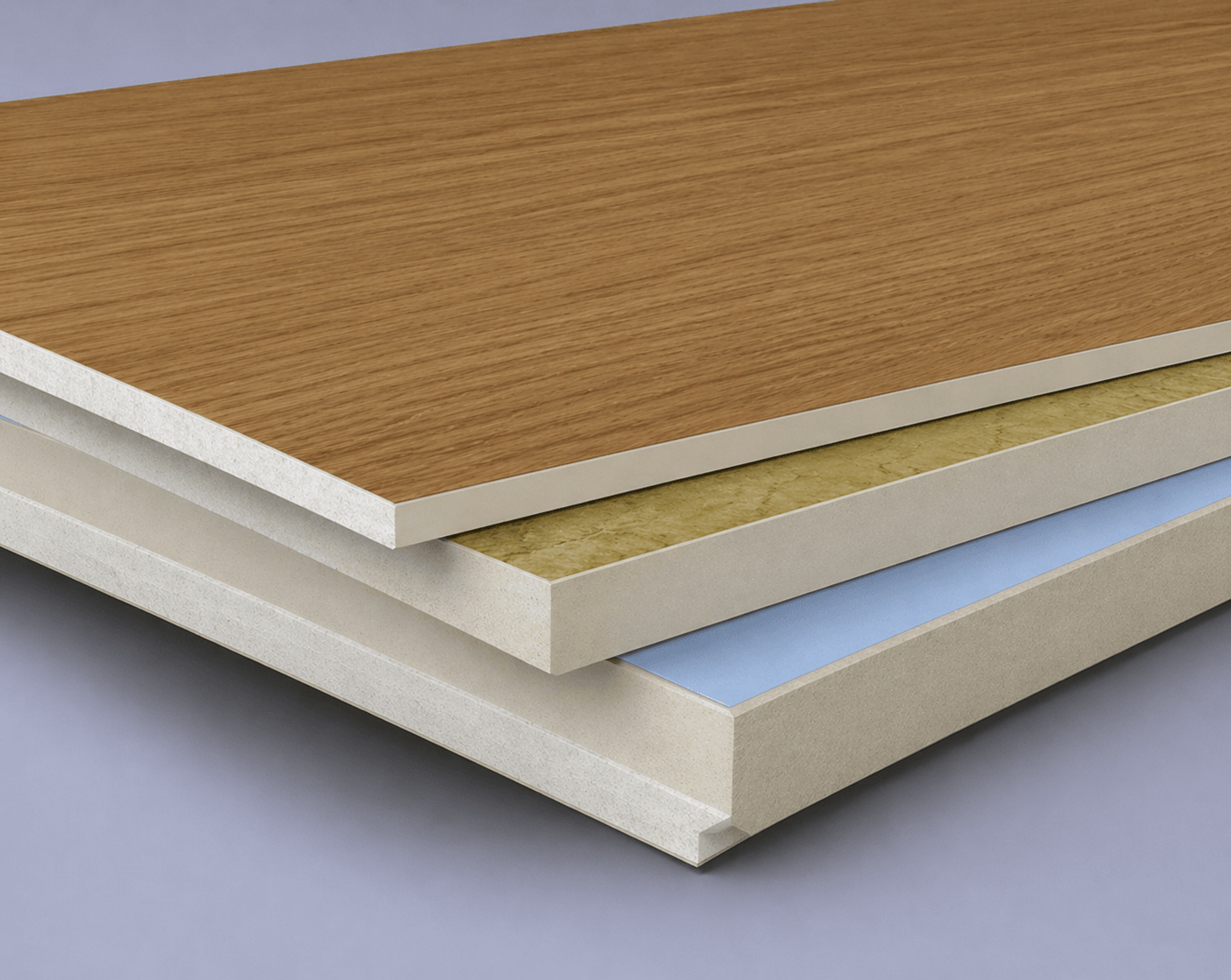
GYPSUN vs Laminated Panels: Safe Solution for Public Interiors
Comparison of GYPSUN and laminated panels: fire safety, durability and environmental friendliness. Why GYPSUN is the best choice for hospitals, schools and administrative buildings.
Modern requirements for finishing public buildings — hospitals, schools, administrative centres — have changed significantly. If in the past aesthetics was the only key factor, today fire safety, environmental friendliness, durability and compliance with building codes come to the forefront.
Most often customers choose between two solutions: laminated panels and innovative GYPSUN panels based on GKL or GVL. Let us examine in detail why these materials are not equivalent and which option is truly beneficial in the long term perspective.
What Are Laminated Panels
Laminated panels are typically a substrate of MDF, particle board or plastic with decorative coating (laminate, HPL, PVC film). They are widely used due to:
attractive appearance
quick installation
wide range of textures
However, behind the attractive exterior often lie significant limitations.
Main Drawbacks of Laminated Panels
Fire Hazard
Most laminated panels are combustible or low-combustible materials. During a fire they:
ignite quickly
emit toxic smoke
contribute to fire spread
For facilities with large numbers of occupants, this is a critical risk.
Low Wear Resistance
The laminated coating over time:
scratches
peels off
loses appearance
This happens especially quickly in hospitals, schools and corridors with heavy traffic.
Environmental Concerns
Cheap panels may contain:
formaldehyde
volatile organic compounds
This creates health risks, especially in medical and educational facilities.
What Are GYPSUN Panels
GYPSUN panels are a modern solution based on:
gypsum plasterboard (GKL)
gypsum fibreboard (GVL)
with a decorative ultra-thin coating.
They are specifically designed for facilities with high safety and durability requirements.
Key Advantages of GYPSUN
Fire Safety — The Main Advantage
GYPSUN panels:
belong to non-combustible or low-combustible materials
do not support combustion
do not emit toxic gases
This makes them an optimal solution for:
hospitals
schools
government institutions
shelters
Durability and Load Resistance
Unlike laminated panels, GYPSUN:
do not delaminate
are not afraid of impacts
maintain appearance for years
The surface is resistant to abrasion and easy to maintain.
Environmental Safety
The GKL / GVL substrate:
contains no harmful impurities
meets sanitary standards
can be used in medical facilities
This is fundamentally important for modern projects.
Geometric Stability
GYPSUN panels:
do not deform when temperature changes
do not react to humidity like MDF or particle board
provide a level surface throughout the entire operating period
Modern Design Without Compromise
Despite its technical advantages, GYPSUN does not compromise on aesthetics:
solid colour solutions
wood textures
matte and gloss finishes
Whilst the decorative layer does not affect fire characteristics.
Where the Difference Becomes Critical
Material selection is especially important in:
hospitals and clinics
schools and kindergartens
administrative buildings
facilities with high fire safety requirements
It is here that laminated panels fall short not just in characteristics, but in standards compliance.
Conclusion
Laminated panels are a solution suitable for commercial or private interiors with low safety requirements. However, in modern public building construction they are gradually losing relevance.
GYPSUN panels are a systematic approach to finishing, combining:
fire safety
durability
environmental friendliness
modern design
This is why GYPSUN becomes the logical choice for projects where not only aesthetics matter, but also responsibility for people's safety.


