
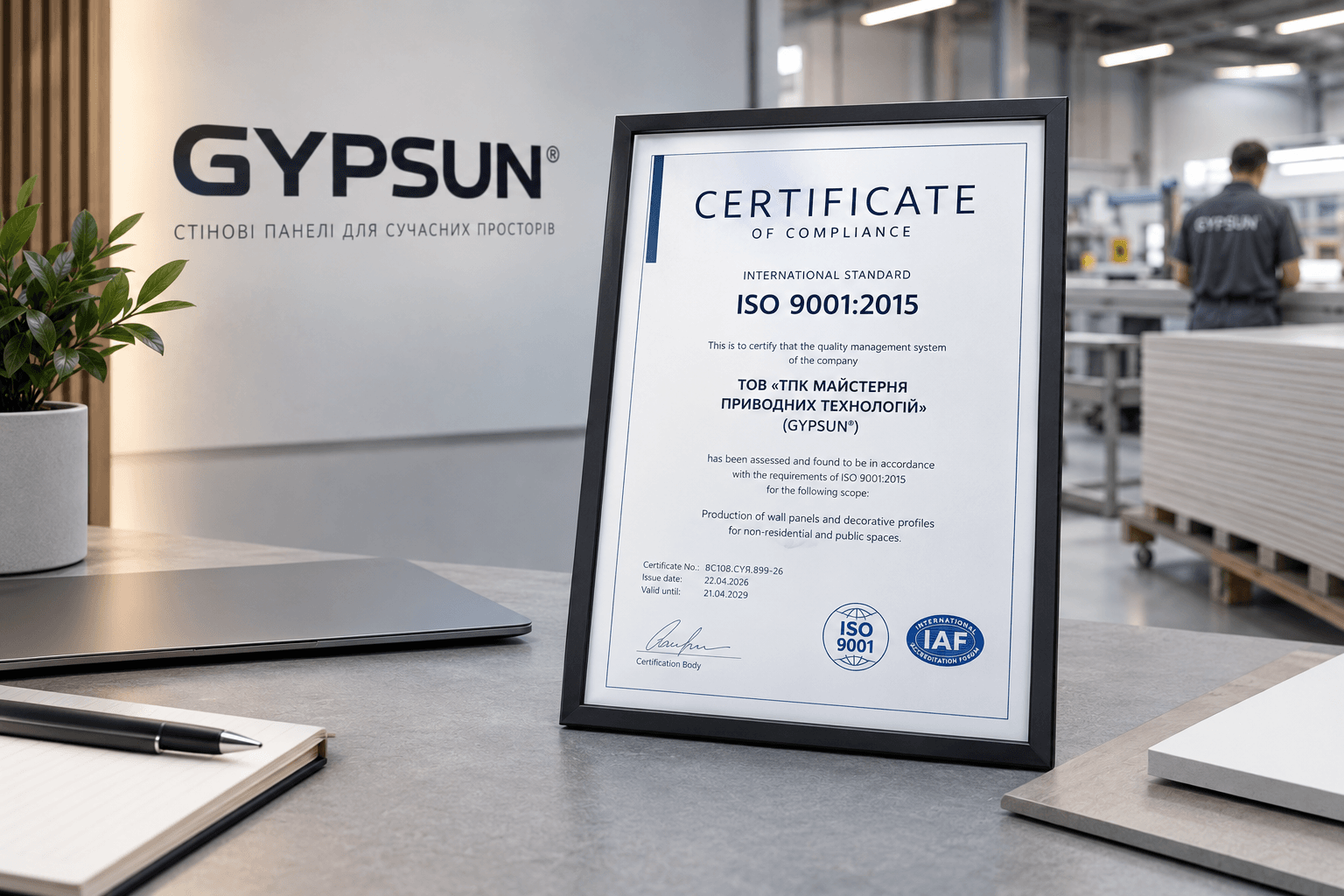
ISO 9001:2015 — what does a quality management system certificate mean and why is it important in construction
ISO 9001:2015 is an international standard for quality management systems. Find out what the certificate confirms, how to check its validity, and why it is important for building materials manufacturers and tenderers.
In modern construction, customers evaluate not only the cost of materials. Production stability, control of technological processes, documentary confirmation of product characteristics, and the supplier's ability to fulfill contractual obligations are becoming important.
This is especially true for building materials used in hospitals, educational institutions, administrative buildings, and other public facilities. In such facilities, errors in material selection or work organization can lead to additional costs, delays, and the need for repeated repairs.
One of the tools for system management of these processes is ISO 9001:2015, an international standard for quality management systems .
Certification to this standard helps an enterprise streamline production and management processes, define employee responsibilities, control risks, and consistently improve performance.
At the same time, it is important to understand what exactly the ISO 9001 certificate confirms, what opportunities it creates for the enterprise, and why it cannot be equated with a certificate of conformity for a specific building material.
What is ISO 9001:2015?
ISO 9001:2015 is a standard developed by the International Organization for Standardization (ISO). It sets out requirements for an organization's quality management system.
The main goal of the standard is to ensure a systematic approach to organizing work, meeting customer requirements, complying with applicable regulatory requirements, and continuously improving processes.
The standard can be applied by enterprises of various sizes and different industries: from the production of building materials to engineering, trade and service companies.
ISO 9001 does not set universal specifications for all products. Instead, it defines requirements for the system by which a company organizes and controls its activities.
For a manufacturer, this means understanding how orders are fulfilled, who is responsible for individual operations, how nonconformities are controlled, and how the company works to improve results.
What does the ISO 9001 certificate confirm?
The ISO 9001 certificate confirms that the company's quality management system has passed an appropriate assessment within the defined scope of certification.
Typically, such a system covers several key areas.
Process management. The enterprise defines the main processes, their sequence, relationships, and responsible persons.
Quality control. Procedures are established for verifying work results and responding to identified nonconformities.
Working with customers. The organization must take into account customer requirements, agreed contractual terms and conditions, and applicable regulatory requirements.
Risk management. The enterprise identifies risks that may affect the quality of work and plans appropriate measures.
Documentation. Important processes, procedures and control results are documented in accordance with the requirements of the quality management system.
Continuous improvement. The organization analyzes performance, identifies problems, and implements corrective actions.
The combination of these elements creates the basis for more predictable enterprise operations.
ISO 9001 in the production of building materials
The production of building materials involves the interaction of many processes. These include the purchase of raw materials, checking their characteristics, setting up equipment, performing technological operations, controlling finished products, packaging and shipping.
A violation at any of these stages can affect the final result.
A quality management system helps streamline these processes and establish clear operating rules.
For a wall panel manufacturer, for example, it may be important to monitor substrate parameters, adhere to coating technology, check appearance, identify batches, and document test results.
The specific list of controlled parameters is determined by the production technology, product characteristics and requirements.
However, ISO 9001 does not in itself confirm that each panel has a certain class of reaction to fire, a given mechanical strength or resistance to specific cleaning agents. Such characteristics are confirmed by appropriate tests, technical documentation and other appropriate documents.
Why ISO 9001 is important for building materials customers
For a customer, cooperation with a manufacturer or supplier involves evaluating more than just the price.
It is necessary to understand how consistently the company fulfills orders, how process control is organized, and whether it is able to operate in accordance with agreed requirements.
A certified quality management system can be one factor in such an assessment.
It helps the customer obtain additional information about the organization of the enterprise's work, but does not replace checking its production capabilities, experience, technical documentation, and actual delivery results.
This is especially important for large construction projects. The supply may involve significant volumes of materials, multiple shipping stages, and coordination of technical parameters with project documentation.
The more complex the object, the more important it is to determine in advance the product requirements, acceptance procedure, and responsibilities of the parties.
ISO 9001 and participation in public procurement
Participation in tenders implies compliance with the requirements of a specific procurement. The customer may set conditions regarding the technical characteristics of the products, the qualifications of the participants, documents and confirmation of the conformity of the subject of the procurement.
In certain cases, the procurement documentation may contain requirements for a quality management system or relevant supporting documents. Their legality and applicability depend on the specific procedure and applicable legislation.
The mere fact of having an ISO 9001 certificate does not guarantee victory in a tender and does not mean automatic admission to any procurement.
Before submitting a proposal, you must check:
tender documentation requirements;
the scope of the certificate;
its validity period;
details of the enterprise for which the document was issued;
requirements for confirming product characteristics;
other documents stipulated by the procurement conditions.
This approach helps to avoid errors when forming a tender offer.
How is ISO 9001 different from a product conformity certificate?
This is one of the most important issues when choosing building materials.
ISO 9001 refers to an organization's quality management system. A certificate or other document of product conformity, depending on the applicable procedure, refers to the specified characteristics of a specific product.
These documents have different purposes.
For example, a company may have a certified quality management system, but to use its panels in a specific room, it is still necessary to check the fire characteristics, installation conditions, permissible cleaning modes, and other parameters provided for by the project.
Similarly, the presence of a document for an individual product does not mean automatic certification of the manufacturer's quality management system.
For an informed choice, it is necessary to evaluate both areas separately: the organization of enterprise processes and product characteristics.
How to check ISO 9001 certificate
When checking a certificate, it is advisable to pay attention to several key points.
1. Company name. It must correspond to a legal entity whose activities are confirmed by a document.
2. Standard: Check the specified revision of ISO 9001 or the national standard by which it is adopted.
3. Scope of certification. It determines which types of enterprise activities the document applies to.
4. Certification body. It is necessary to check its name, competence and, if relevant for the specific procedure, accreditation.
5. Registration number. It helps to identify the document in the relevant register or directly in the body that issued it.
6. Expiration and status: It is important to check whether the certificate has expired, been suspended, or revoked.
7. Confirmation from the publisher's source. If the information is in doubt, it is advisable to contact a certification body or check an available official registry.
The presence of the ISO logo or an image of the certificate on a company's website is not in itself sufficient confirmation of its current status.
Does ISO 9001 guarantee high quality of each product?
Quality management system certification does not mean that every product is automatically defect-free.
Its purpose is to establish a systematic approach to process management, meeting requirements, and improving the organization's performance.
The outcome depends on how the system is implemented and maintained in practice.
Therefore, when purchasing building materials, it is worth considering a combination of factors: technical documentation, test results, product control, warranty conditions, production capabilities, and experience in fulfilling orders.
ISO 9001 is an important element of this assessment, but does not replace it.
ISO 9001 as part of a systems approach to construction
Modern construction requires coordinated work between manufacturers, designers, suppliers, and contractors.
Not only the installation result, but also the further operation of the building depends on the quality of interaction between them.
That is why standardized quality management processes are of particular importance. They help companies formalize responsibility, streamline document flow, control risks, and operate in accordance with defined requirements.
For the customer, this creates an additional basis for evaluating the supplier. For the manufacturer, it provides an opportunity to systematically analyze and improve their own processes.
At the same time, certification should be part of a real management system, not just a document to demonstrate during negotiations or participation in tenders.
Conclusion
ISO 9001:2015 is an international standard that helps businesses organize a quality management system, control processes, and work on continuous improvement.
In the construction industry, it has practical significance for material manufacturers, suppliers, contractors, and customers who seek to evaluate not only the price of the offer, but also the organization of the work of the counterparty.
However, a quality management system certificate should not be confused with documents confirming specific technical characteristics of products.
A reliable approach involves checking the certificate itself, its scope, the status of the certification body, and separate confirmation of the properties of the materials.
ISO 9001 is a quality management system tool. Its value is determined not only by the existence of the document, but also by how consistently the company applies the established principles in its daily work.


